


Do you want to become a security guard but haven’t applied yet because you don’t have experience?
We’ve seen aspiring guards talk themselves out of even trying to apply to jobs, convinced that without time on the clock, they don’t stand a chance against experienced applicants.
However, security is one of the few fields where being dependable and willing to work matters more than what’s on your resume. Companies aren’t just looking for experience, and many are more interested in hiring reliable people who won’t let them down.
If you want to get your foot in the door, this guide covers exactly what you need to do. Before you know it, you’ll have your license, be submitting applications, and have your first security guard job booked.
Do Security Guard Jobs Really Require Experience?
No. Most entry-level security guard positions don’t require any prior experience.
A resume full of security experience is nice to have, but not having any is usually not a dealbreaker for employers, as most companies are looking for applicants who are focused, reliable, and willing to learn.
Security work often involves following procedures, staying alert during long shifts, writing basic reports, and interacting professionally with employees, customers, or visitors. Employers know these skills can be developed on the job, which is why many are willing to hire candidates with little or no security experience.
There are also plenty of transferable skills that can prepare you for security guard positions, such as experience in customer service, retail, hospitality, or other public-facing roles.
The one exception is armed positions. Those require additional firearms licensing, and many companies want you to have logged time as an unarmed guard first before they’ll consider you.
If you want to work as an armed security guard, you’ll typically need to complete state-required firearms training and meet any licensing requirements that apply in your area. Many guards start in unarmed roles, gain experience, and then move into armed positions later in their careers.

What Employers Look for Instead of Experience
Security companies aren’t hiring based on how many hours you’ve already been on the clock.
They’re hiring based on whether they think you are capable of performing security guard duties.
Here’s what actually matters to them:
- Reliability and punctuality: The best security guards arrive on time and don’t leave their colleagues covering for them. Security shifts need to be filled, and a candidate who can demonstrate they’ll be there every time is worth more to a hiring manager than someone with experience who’s already shown a pattern of calling out.
On your resume, highlight roles with consistent attendance or long tenure.
When it comes to your job interview, show up early to make a good first impression.
- A clean background check. Security guards are trusted with protecting people and property, so employers place a strong emphasis on reliability and professionalism.
Most companies conduct background screenings as part of the hiring process, and a clean record can put you in front of other candidates.
- Flexibility: Security doesn’t run nine-to-five. Employers need people who can cover days, evenings, and overnight shifts and who won’t push back every time the schedule changes.
Being upfront about your availability and keeping it as wide as possible when you’re starting out makes you a much easier hire.
- A high school diploma or GED: Many employers use a high school diploma or GED as a basic hiring requirement because it demonstrates a level of commitment and responsibility.
While security guards come from many different backgrounds, companies want to know that applicants can follow instructions and meet workplace expectations, and a diploma or GED can demonstrate that.
- A valid driver’s license. Even if the position isn’t specifically a driving role, many employers prefer candidates with reliable transportation who can travel to different sites as needed.
Some security jobs also involve vehicle patrols or covering shifts at multiple locations, which requires a driving license, so if you have a valid license and a good driving record, be sure to highlight it on your application.
- Basic physical fitness: You don’t need to be an athlete to work as a guard, but you do need to be able to stand for long periods and walk long distances across a client’s site.
Most unarmed roles don’t involve a physical fitness test, but employers will notice if you look like someone who’s going to struggle to make it through a full shift.
- Documentation skills. A significant part of the job is written, and every shift you’ll be writing incident reports, logs, or handover notes. If you’ve ever had a job where you wrote emails, filled out forms, or documented anything at all, mention it on your application, as it shows employers you can handle the paperwork side of the role.

How to Land Your First Security Guard Job
Our step-by-step guide will help walk you through all that you need to do to prepare and apply for your first job in security.
Step 1: Get Your License
The absolute first thing you should do is apply for a security license (sometimes called a guard card) in your state. This is the single most effective thing you can do to compensate for a lack of experience, and in most states, it’s a legal requirement before an employer can hire you anyway.
A guard license is a state-issued certificate that legally allows you to work as a security guard.
In some states, you may be allowed to begin working while your application is being processed. Even so, employers generally prefer candidates who have already started the licensing process or have their license in hand. It shows initiative and makes it easier for a company to place you on a site quickly.
Check out our guide to state security guard license requirements to learn exactly what you need to do.
In most cases, you’ll have to:
- Be at least 18
- Complete a set number of training hours
- Submit your fingerprints to pass a background check
- Mail or submit your application digitally with the applicable fees.
It will take from a couple of weeks to a month or two to receive your license once you begin applying, and we highly recommend starting the process as soon as you can, especially if you need to complete training.
Step 2: Take a Training Course
Most people applying for entry-level security jobs do the bare minimum by filling out an application and hoping for the best.
You can stand out from a stack of applications from people who haven’t done anything to prepare by completing your own training in advance.
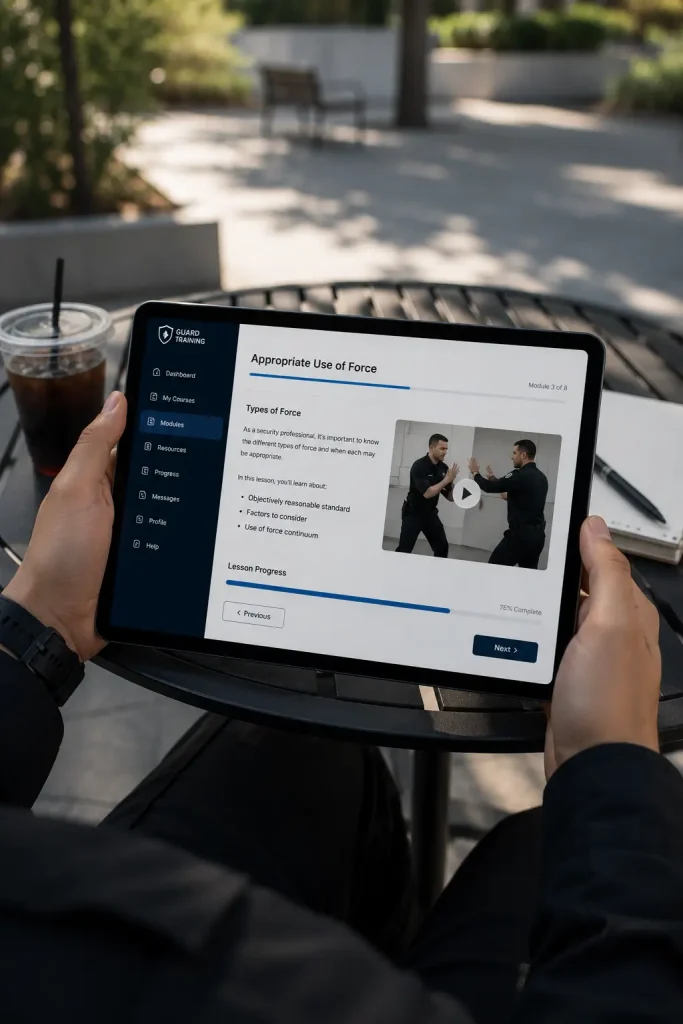
As opposed to mandatory (often in-class) training for your licenses, you can complete online or hybrid security guard training in your own time.
Your first few weeks as a guard will involve a lot of learning on the fly, and you’ll be expected to quickly get the grasp of procedures, terminology, and how to handle situations you’ve never faced before. Going in with even basic knowledge makes it that much less overwhelming.
Some courses we recommend to get you started include:
- Observation & Documentation: Teaches report writing, incident documentation, observation techniques, and the proper way to record events. These skills can help you produce clear, accurate reports and demonstrate one of the most valuable abilities employers look for in new guards.
- Officer Safety: Covers situational awareness, threat recognition, de-escalation techniques, and emergency response procedures. This knowledge can help you make better decisions in the field and show employers that you understand the safety responsibilities that come with the job.
- Access Control: Explains visitor management, identification procedures, alarm systems, CCTV monitoring, and access control technologies. This course provides a strong introduction to one of the most common responsibilities you’ll encounter as a security guard.
- Appropriate Use of Force: Teaches legal standards for using force, de-escalation techniques, the force continuum, and self-defense principles. These skills help you understand how to respond safely and within policy during high-pressure situations and show employers that you’re prepared to handle real-world incidents responsibly.
If you’re already working another job, you don’t need to carve out huge blocks of time.
Most of these courses are self-paced, meaning you can work through them in the evenings or on weekends without disrupting your current schedule.
We suggest completing one or two courses before you start applying to jobs.
Step 3: Build a Resume That Works in Your Favor
When creating your security guard resume, your goal is to take what you’ve already done and reframe it to make it read as security-relevant.
You need to make sure the hiring manager can see the connection between your background and the role, rather than leaving them to figure it out on their own.
Start with a strong opening statement.
The top of your resume should include a short two- to three-sentence summary that clearly highlights your strengths and the type of role you’re targeting. This section sets the tone for the rest of your application and helps employers quickly understand what you bring to the position.
Don’t open with: “I am looking for a security guard position with no experience.”
Instead, lead with what you bring:
“Reliable and physically fit candidate with a current guard card and a background in customer-facing roles. Completed training in conflict resolution and first aid. Available for all shifts, including nights and weekends.”
Reframe your previous jobs.
When listing your previous jobs, don’t undersell yourself. Almost every job has transferable skills that matter in security, and you just need to present them the right way.
Here are some examples:
| Previous Role | How to Frame It |
| Retail assistant | Monitored store floor, managed customer disputes, and maintained a safe environment |
| Warehouse operative | Followed strict safety protocols, controlled access to restricted areas, and kept accurate logs |
| Driver | Conducted vehicle checks, managed independent routes, and maintained alertness over long periods |
| Customer service | De-escalated difficult situations and communicated clearly under pressure, |
| Hospitality | Managed large crowds, monitored the venue for safety issues, and dealt with intoxicated customers |
The key is to use action words, such as monitored, controlled, documented, responded, and maintained, rather than just listing job duties passively.
If you have no prior work experience at all, focus on school responsibilities, volunteering, group projects, or everyday situations where you had to follow instructions, stay reliable, or work with others, such as helping organize a school event, participating in a sports team, completing assigned roles in group assignments, or taking on responsibilities at home.
Put your license and courses at the top.
If your work history is thin, don’t bury your guard card and any completed courses at the bottom.
Create a certifications section and put it above your work history, since it’s the most relevant thing on the page.
Keep it to one page.
Don’t try to pad out your resume with unnecessary details, as this can make it harder for recruiters to quickly identify your qualifications.
A clean, easy-to-read one-page resume allows hiring managers to find the information they’re looking for at a glance, so use clear headings and include enough white space to keep the document organized and uncluttered.

Step 4: Apply to Suitable Roles
Not every security job is suitable for someone just starting out. When searching on job sites such as Indeed or ZipRecruiter, focus on these types of roles:
- Large private security contractors often accept entry-level applicants and train employees in-house.
- Retail and loss prevention roles mostly revolve around observation and customer interaction, making them suitable for people starting out in the field.
- Event and venue security is typically part-time and flexible, which is ideal for building hours and experience quickly.
- Residential and gated community security roles are quieter and lower pressure, which is good for building confidence in your first role.
You can also look up security companies in your area on Google Maps or in local business directories, then apply directly on their websites. This can be helpful because many companies post openings on their own career pages first, and applying directly often gets your application in front of the hiring team faster than waiting for job boards to update.
Step 5: Ace your Interview
When preparing for your interview, practice some answers to common interview questions. That way, you won’t get caught by surprise, and you can show your composure.
You can also expect the interviewer to ask about your lack of experience, and the worst thing you can do is get flustered or apologetic about it.
Instead, prepare a confident pivot answer ready, such as:
“I don’t have direct security experience, but I have my guard card, I’ve completed training in conflict resolution and first aid, and I have a background in [previous role] where I regularly dealt with [relevant situations]. I’m ready to start immediately.”
All you really need to do is acknowledge it, pivot to what you bring to the table, and move on.
Questions you’re likely to be asked:
What to wear. Dress in business casual attire, such as a button-down shirt with dress pants or chinos, to show you can be presentable and professional in appearance.
What to bring. A printed copy of your resume, your guard card, and a list of references. Having physical copies shows your organization and saves everyone time if they ask for them on the spot.
Tip: Familiarize yourself with basic post terminology before you walk in. Terms like “post orders,” “incident report,” “access control,” and “radio check-ins” come up quickly in interviews, and knowing what they mean without hesitation shows the interviewer you’re serious about this career.

Prepare for Your First Security Guard Job
Now you know that you don’t need experience to get hired as a security guard.
What you do need is a license, a resume that makes the most of what you already have, and the confidence to apply to the right roles and nail your interviews.
Follow the steps in this guide, and you’ll be ahead of most entry-level applicants.
If you want to go one step further and show employers you’re serious before you’ve set foot on a site, take a look at the online training courses we offer at GuardTraining.
Our courses are self-paced and beginner-friendly, helping you build the foundational knowledge that makes a difference in interviews and on your first day.
Try our courses today, or explore our blog for more guidance on what it takes to land a security guard job and build a career in this industry.
