


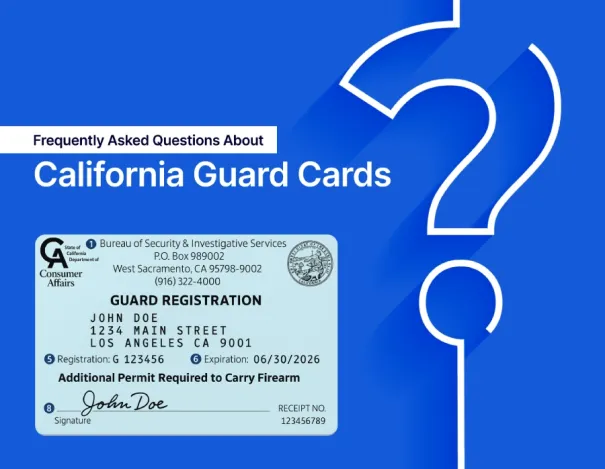
If you’re considering a career in security, one of the first things you’ll need is a guard card.
Guard cards are official licenses that allow you to work legally as a security professional, and they come with specific requirements, training, and renewal rules.
Many people have questions about the process, eligibility, and costs, so we’ve put together this comprehensive FAQ to give you clear answers.
Jump to your question:
- What Is a California Guard Card?
- How Old Do I Need to Be to Apply for a Guard Card?
- Can I Apply for a Guard Card Online?
- How Long Does It Take to Get a Guard Card?
- What Documents Do I Need to Apply for a Guard Card?
- Do I Need Training Before Applying for a Guard Card?
- How Much Does a Guard Card Cost?
- Can I Get a Free Guard Card?
- Can a Felon Get a Guard Card?
- How Long Is a Guard Card Valid?
- How Do I Renew My Guard Card?
- How Much Does It Cost to Renew My Guard Card?
- Can I Work as a Security Guard Without a Guard Card?
- Can I Work In Multiple States With One Guard Card?
- What Happens if My Guard Card Is Lost or Stolen?
Prepare for the Guard Card Application Process With Guard Training
1. What Is a California Guard Card?
A California guard card is a license that allows you to work as a private security guard in the state. Before you can legally work as a guard, you must provide proof that you’ve completed the required training and passed a background check, though specific requirements can vary.
The guard card is issued by the Bureau of Security and Investigative Services (BSIS) and applies to both part-time and full-time officers. You need it before reporting to any post.
2. How Old Do I Need to Be to Apply for a Guard Card?
You need to be at least 18 years old to apply for a California guard card. That’s the minimum age to work as a security guard in the state.
3. Can I Apply for a Guard Card Online?
Yes, you can apply for a security guard registration online through BreEZe, California’s official online licensing and application system.
To get started, create an account on the BreEZe portal and begin setting up your profile. From there, you can submit your application, upload required documents, and track the progress of your guard card registration.
If you prefer, you can also apply by mail. Download the Application for Security Guard Registration. Then, mail the completed application and fee to the Bureau.

4. How Long Does It Take to Get a Guard Card?
Adding all steps together, obtaining a California guard card typically takes approximately 6 to 8 weeks, depending on how quickly you complete training, fingerprinting, and background checks.
Before applying, applicants must complete the Power to Arrest course, an 8-hour mandatory training course, which can typically be completed in several days of focused study or split over a couple of shorter sessions throughout a week or two.
Then, you’ll need to get fingerprinted at a nearby Live Scan provider. Live Scan background checks processed by the California DOJ typically return results within 1 to 7 days, with most submissions received by the requesting agency in 24 to 72 hours if there are no issues.
A federal background check through the FBI is required in addition to the state check, and results usually take 3 to 5 days after fingerprints are submitted. FBI checks are often processed simultaneously with the state check, but in rare cases, they may take longer.
Once all information is submitted and verified, the overall processing time with BSIS is around 4 to 6 weeks, leading to up to 8 weeks to obtain a guard card in California.
5. Do I Need Training Before Applying for a Guard Card?
Yes, you’ll need to complete the Power to Arrest training before you can apply for a guard card in California.
On top of that, you have to finish 32 hours of security officer skills training within the first six months after registering. Once you’re set up, you’ll also need to do 8 hours of refresher training every year to maintain your card’s validity.
6. What Documents Do I Need to Apply for a Guard Card?
When you’re ready to apply for a California guard card, you’ll need a few key documents to prove your training and eligibility.
After finishing your Power to Arrest course, your training provider will give you a Certificate of Completion. Make sure to include the serial number on that certificate when you submit your application.
You’ll also need to provide the right BSIS license, certificate, or approval number. If you did your training through your employer’s Private Patrol Operator (PPO), use the PPO’s BSIS license number. If you trained with an approved individual trainer, give the trainer’s BSIS approval number.
If you’re an honorably discharged active-duty member of the U.S. Armed Forces and want expedited service, you’ll need to include a copy of your DD-214 or DD-215 to show your service and discharge status.
7. How Much Does a Guard Card Cost?
You can expect to pay approximately $229 – $254 to obtain a guard card. Keep in mind that costs may vary slightly depending on your location and the training provider you choose.
Here’s a breakdown of the typical cost of a California Guard Card. :
- BSIS Initial Application Fee: $55 – This fee covers the processing of your guard card application with the Bureau of Security and Investigative Services (BSIS).
- Fingerprinting: Approximately $74 – $99 – You’ll need to get fingerprinted through a Live Scan provider so your criminal background check can be completed.
- Mandatory Training Courses: Around $100 total – This includes about $20 for the initial required training and roughly $80 for additional courses, depending on the provider.
8. Can I Get a Free Guard Card?
No, unfortunately, you cannot get a California guard card for free.
However, some city governments and job centers offer free training programs for low-income residents.
Alternatively, certain employers may cover the cost of the 32 additional hours of training required for new employees after receiving their guard cards.
These options can help reduce your overall expenses, even though the guard card itself still carries a fee.

9. Can a Felon Get a Guard Card?
Having a felony makes it less likely you’ll get a guard card, but there’s no guaranteed answer. When you submit your fingerprints for a criminal background check through the DOJ and FBI, the BSIS reviews any prior convictions.
Each case is considered individually, looking at the type of felony, how much time has passed since the conviction, and any evidence of rehabilitation. Because of this, some applicants with felonies are approved while others are not.
The BSIS can deny a guard card based on a felony, but they also allow appeals and consider evidence showing you’ve been rehabilitated. However, you won’t know for sure until you apply.
10. How Long Is a Guard Card Valid?
A California guard card is usually valid for 2 years from the date it is issued. The BSIS automatically mails a registration renewal form to the registrant’s address of record about 90 days before the card expires.
This gives you plenty of time to complete any required training and submit your renewal application.
11. How Do I Renew My Guard Card?
Check the status of your guard card using the DCA License Search. This online tool lets you verify any license and shows whether your card is current, expired, or has been subject to disciplinary actions such as suspension or revocation.
All guards must submit the completed renewal application or renewal coupon at least 60 days before their card expires. This gives the Bureau enough time to process the renewal without delays.
You can download and fill out the renewal application form, or renew your guard card online through the BreEZe portal.
You must submit the BSIS renewal application, pay the required fee, and provide proof that you’ve completed the necessary BSIS continuing education training.
This includes 32 hours of security guard skills training within the first six months: at least 16 hours within the first 30 days, and the remaining 16 hours within six months. After that, you must complete 8 hours of annual training.
If your guard card has already expired, you’ll follow the same steps as a first-time applicant. The only difference is that you’ll enter your expired guard card number on the California State Security Guard Application.
11. How Much Does It Cost to Renew My Guard Card?
Renewing a California guard card requires a $40 fee for the renewal application.
If you submit your renewal application after your registration has expired but within 60 days, you must also pay a delinquency fee of $25 in addition to the standard renewal fee.
13. Can I Work as a Security Guard Without a Guard Card?
No, in California, you cannot legally work as a security guard without a valid guard card. State law requires that you carry a valid guard card while on duty.
You can still apply for jobs before your guard card is issued, as long as your name and guard registration number appear on the BSIS website.
14. Can I Work In Multiple States With One Guard Card?
No, a single guard card only works in the state where it was issued. Each state sets its own rules and requirements for security guards, so when you receive your guard card, you are only permitted to work in California.
However, within California, your guard card lets you work for different employers or move between jobs without needing a new card, as long as your registration remains valid.

15. What Happens if My Guard Card Is Lost or Stolen?
If your guard card is lost, damaged, or stolen, you can request a replacement. To do this, submit an Application for Replacement of Security Guard Registration Card to the BSIS.
You’ll need to fill out your general contact information, explain why a replacement is needed, and pay the $25 fee.
You must notify your employer and apply for a replacement within 72 hours of losing, destroying, or having your card stolen. Replacement processing typically takes 6 to 8 weeks.
Prepare for the Guard Card Application Process With Guard Training
Obtaining your guard card in California can feel daunting, but with clear answers to frequently asked questions, the process becomes much easier.
Are you ready to begin the guard card application process? Explore Guard Training’s online Power to Arrest and security officer skills training courses to meet the state’s requirements and move forward with your application.
Once you’re licensed, our other courses can help you sharpen your skills and grow into a proficient, confident security professional.